The 95 Days of Christmas
Day 1
Welcome to the 95 Days of Christmas
Each day we'll look at three things:
- Martin Luther's 95 Theses
- A New 95 Theses
- The
Christmas
Conspiracy
We'll start off with the first three theses, since they go together.
|
Disputation on the
Power and Efficacy of Indulgences Commonly Known as
The 95 Theses
by Dr. Martin Luther
Out of love and concern for the truth, and with the object of
eliciting it, the following heads will be the subject of a public
discussion at Wittenberg under the presidency of the reverend
father, Martin Luther, Augustinian, Master of Arts and Sacred
Theology, and duly appointed Lecturer on these subjects in that
place. He requests that whoever cannot be present personally to
debate the matter orally will do so in absence in writing.
- When our Lord and Master, Jesus Christ, said "Repent,"
He called for the
entire life of believers to be one of repentance.
- The word cannot be properly understood as referring to the
sacrament of penance, i.e. confession and satisfaction, as
administered by the clergy.
- Yet its meaning is not restricted to repentance in one's
heart; for such repentance is null unless it produces outward
signs in various mortifications of the flesh.
|
Comments on Luther's Theses
Scholars agree that Luther (and the Protestant Reformation) changed
the Western World. Luther's doctrine of "Justification by
Faith" shook the entire Christian Church (at that time the Roman
Catholic Church). We're going to be challenging the modern protestant
doctrine of "Justification by Faith" in our New Theses. There may
be a difference between the "modern" doctrine of
"Justification by Faith" and Luther's doctrine. There may be a
difference between the "modern" doctrine of "Justification by
Faith" and that held by some defenders of a doctrine of
"Justification by Faith," and different from that which
might be held by one of the more than 30,000 Protestant denominations. There
are a zillion definitions of "Justification by Faith."
It would be nice if all these Protestants were at least dedicated to
making sure that their definition was the Biblical one. "Semper
Reformanda" -- always reforming. Sometimes we get stuck
on our own definition, and we stop reforming; we stop growing; we stop being
Bereans
(Acts 17:11).
So make a resolution right now: dedicating yourself to begin the
journey to always making sure your understanding of Justification is the
Biblical view: "semper reformanda."
What is "Justification?"
"Justification" means standing before God and being given a
verdict of "just," or "not guilty."
Too many Americans don't even think about the fact that God
is our Judge. Certainly they don't want to imagine God saying to them
"Guilty!" and sending them off to the cosmic hoosgow.
So the most popular definition of "Justification by Faith" is,
"If I believe that I'm saved, I will be." "All
I have to do is believe."
The first three of Luther's 95 Theses contradict the modern doctrine of
"Justification by Faith" held by many Protestants.
Most Americans don't know what "repentance" is. They probably
don't know what the Bible says about justification.
During our year-long program, we'll be studying the
Westminster Standards, including their discussion of "repentance."
Preview:
The
Westminster Confession of Faith: Chapter 15 | Of Repentance unto
Life
Westminster
Larger Catechism | Q76. What is repentance unto life?
Westminster
Shorter Catechism Question 87 | What is repentance unto life?
The Reformers on
the Necessity for Repentance and Sanctification | A Refutation of the
Misrepresentations of the Teaching of the Reformation by Roman Catholic
Apologists By William Webster
Our new version of "Justification by Faith": "Justification
by Allegiance."
The New 95 Theses
Here's the place to start the New Theses:
http://tinyurl.com/1stdayofChristmas
There are four introductory posts:
- Welcome to "The 95 Days of Christmas" | View
- The Importance of Luther's 95 Theses | View
- The Origin of These 95 Theses | View
- Introduction: Taking the Bible Seriously | View
Here is the first of the New Theses: 95
Days of Christmas: Thesis 1: Christ the Word
As I explain elsewhere, these New 95 Theses
constitute a survey of the Bible, going through in chronological order.
Chronologically and theologically, I'm putting John chapter 1:1 ahead of
Genesis 1: "In the beginning was the Word."
This verse tells us two things: Christ is divine, and the Word is divine.
Many don't believe that such a claim is true; they say, "I don't
believe it's true that Christ is divine, and I don't believe it's true that
the Bible is divine. But that's a completely different issue from the
question, "What does the Bible claim?" Does the Bible claim
(whether falsely or truthfully) that Christ is divine?
As we go through the Bible in these 95 Theses, I ask the unbelieving
reader to suspend disbelief in order to accurately understand the claims
made by the Bible. Just ask, "What is this book trying to assert,"
rather than "Is it true?"
If you believe that the Bible claims that priests have a right to molest
you, you will never agree that the Bible is true. And well you shouldn't.
Understanding what the Bible really claims will make it easier for
you to accept it as divine and true, I believe.
The Bible is a story. If you want to say it's a "fairy tale,"
that's fine for now, as long as you make an honest effort to understand the
plot of the fairy tale. Nobody believes that Aesop's Fables are literally
and historically true, but there is still a literary science to
understanding their moral message.
If millions of Christians believe that the Bible claims that George Bush
has a divine right to declare martial law and suspend the Constitution, it's
in your own interest to be able to convince them that the Bible makes no
such claim. You can believe that the Bible is a fairy tale, and that the
world is just a heap of random chemicals, and all meaning is illusion, but
you may live longer if you can help me persuade millions of Christians that
the Bible is libertarian in its moral message.
The Christmas
Conspiracy is a conspiracy to
bring about the fulfillment of the "Vine
& Fig Tree" prophecy of the Old Testament Prophet
Micah. This prophecy is not usually thought of as a "Christmas"
prophecy, but we believe it nicely sums up "the real meaning" of
Christmas.
Vine & Fig Tree is The
Original American Dream.
That's all for today. That last link could keep you busy for hours.
Your Questions
Got a question?
Type it in the box below.
Answers will be posted here.
Questions will be discussed in our next
LIVE Webinar
The Year-Long Program
You're enrolled in a 95-day program. There are other programs that last
an entire year. Here is one:
www.SamuelAdamsCoaching.com
About the author
Luther changed Western Civilization by starting a debate:
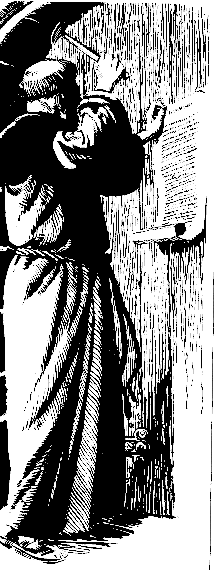
We hope to have the same effect.
|